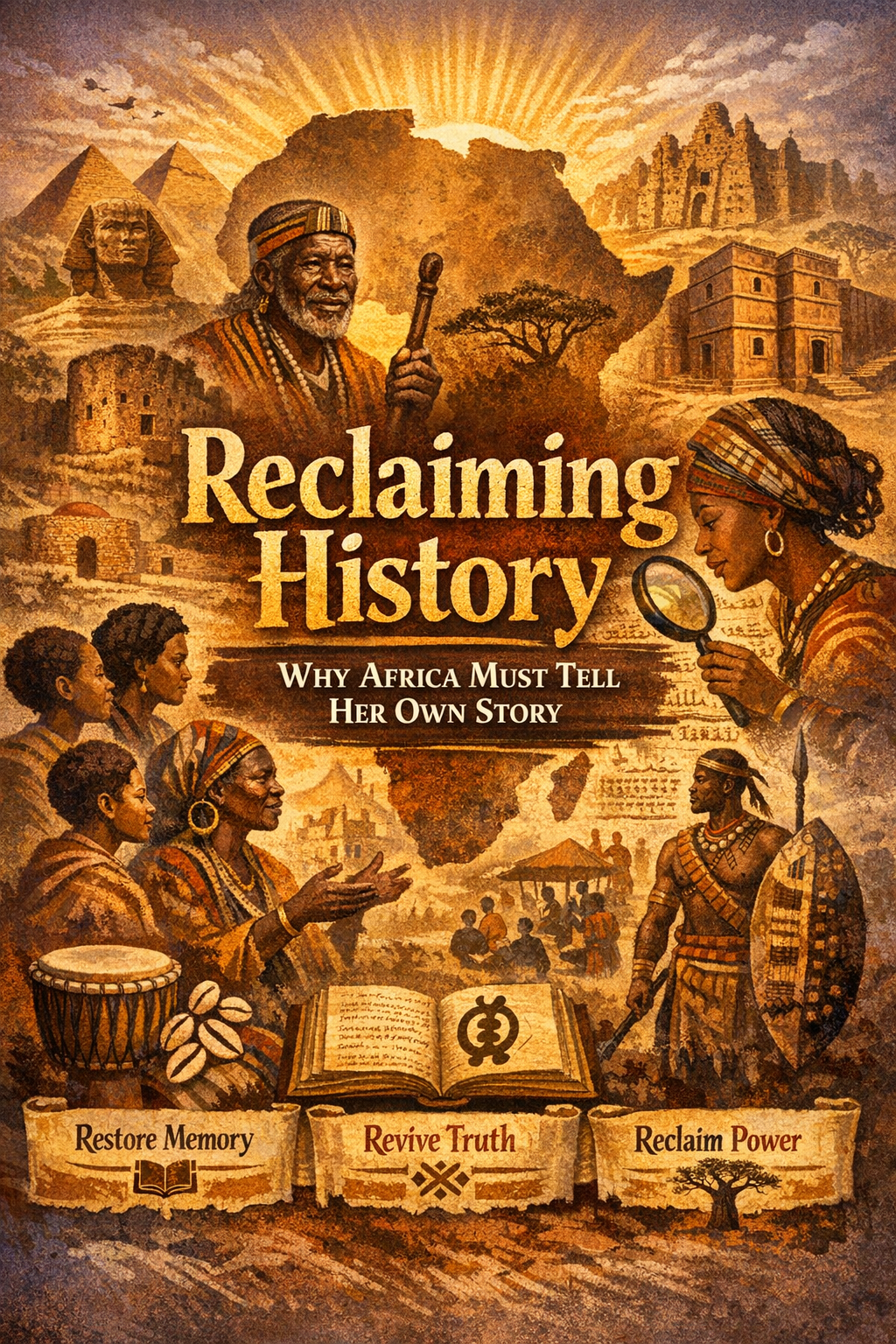

History is never neutral.
It is shaped by those who record it, those who preserve it, and those who decide what is worthy of memory and what may be forgotten. For Africa, history has too often been something done to her rather than by her—written from outside, filtered through foreign eyes, and framed to serve interests far removed from African wellbeing.
To reclaim history, therefore, is not merely an academic exercise. It is an act of restoration, resistance, and renewal.
The Architecture of Erasure
Africa did not lose her history by accident.
The erasure was systematic—embedded in colonial administration, missionary education, museum practices, cartography, and early anthropology. Civilisations were reduced to “tribes.” Advanced systems of governance were dismissed as primitive. Sacred sites became “ruins.” Oral traditions were deemed unreliable, while foreign archives were crowned as authoritative.
In this architecture of erasure, Africa was positioned as a continent without memory, awaiting discovery, naming, and interpretation by others. This myth justified conquest, extraction, and domination. A people without history, after all, could be convinced they had no future.
Yet Africa remembered. She remembered in song and story, in seed and soil, in architecture aligned to the stars, in spiritual systems that ordered society, and in communal laws that governed land, trade, justice, and belonging.
Civilisations Misnamed as Ruins
Across the continent stand sites that are casually described as ruins—Great Zimbabwe, the Swahili city-states, Axum, Timbuktu, Mapungubwe, Meroë, Lalibela, and countless others.
To call these ruins is to suggest decay without continuity.
In truth, they are archives.
They are evidence of advanced metallurgy, astronomy, urban planning, mathematics, governance, trade networks, and philosophy. They speak of African societies that were literate in multiple forms—oral, symbolic, architectural, ecological—long before colonial contact. The problem was never Africa’s absence of civilisation. It was the refusal to recognise civilisation that did not resemble Europe.
Archives Beyond Paper
One of the great deceptions of modern historiography is the belief that truth resides only in written documents stored in climate-controlled rooms.
Africa’s archives are living.
They exist in oral histories carried by elders, in rituals that encode law and memory, in landscapes shaped by centuries of ecological knowledge, and in languages whose metaphors preserve philosophy and worldview.
When these archives are dismissed, entire knowledge systems are rendered invisible. When elders die without being heard, libraries burn silently. Reclaiming history requires expanding our definition of evidence, and respecting Africa’s ways of remembering.
The Violence of Silence
Silence, too, is historical violence.
The silence around the transatlantic and Indian Ocean slave trades as lived African experiences. The silence around forced labour, land dispossession, cultural bans, and epistemic violence. The silence around African resistance, revolts, intellectual traditions, and negotiations.
Where silence prevails, distortion thrives. Reclaiming history demands truth-telling—not to reopen wounds for spectacle, but to close them with honesty. A future built on denial is structurally unstable.
History as Strategy
For Ssali Research Consortium, history is not nostalgia.
It is strategy. It is power!
Historical consciousness shapes how societies understand power, possibility, and self-worth. A continent taught that it has always been behind will accept dependency as destiny. A people reconnected to their ingenuity will demand systems that reflect their capacity. Reclaiming history is therefore inseparable from re-engineering Africa’s political economy, restoring ecological balance, and rebuilding cultural confidence.
Writing Ourselves Back In
To reclaim history is to write ourselves back into the global story—not as footnotes or case studies, but as authors.
It is to research with humility and rigour, to listen as much as we record, and to publish with integrity rather than apology. It is to ensure that Africa’s children encounter themselves in history not as victims alone, but as thinkers, builders, healers, traders, philosophers, and visionaries.
The task before us is immense, but it is also sacred. Memory is inheritance. Truth is freedom. And history, once reclaimed, becomes a compass.