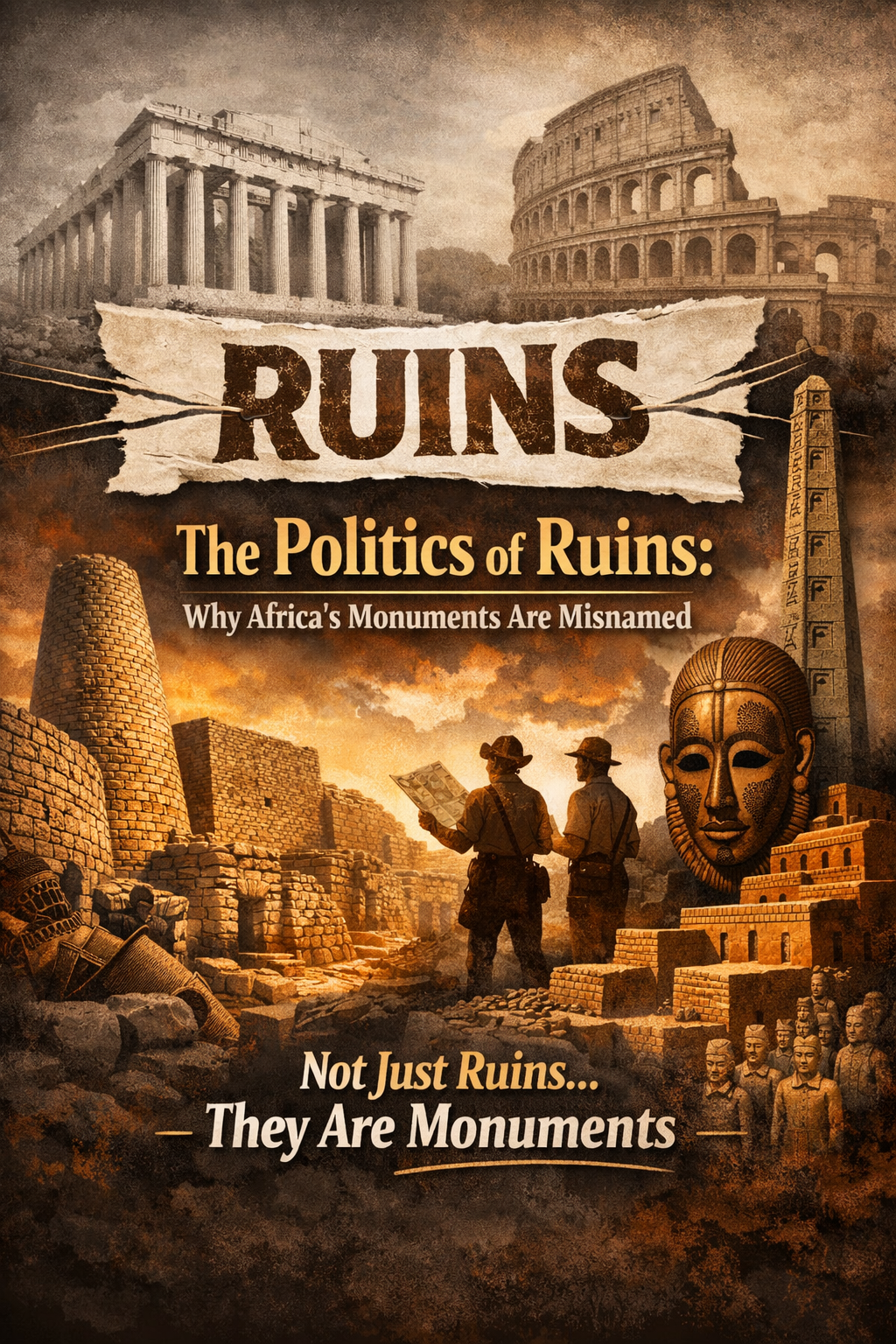

Across Africa, stone walls rise from the earth and are promptly diminished by a single word: ruins.
Great Zimbabwe. The Swahili city-states. Aksum. Thimlich Ohinga. Sungbo’s Eredo. Benin City.
In guidebooks, textbooks, and museum plaques, these sites are framed not as monuments, but as remnants. Not as achievements, but as leftovers.
This language is not accidental. It is political.
To call Africa’s monuments “ruins” is to situate them firmly in the past, to suggest collapse without acknowledging creation, and to imply that greatness once existed but could not endure. The word performs a subtle violence. It detaches these structures from continuity, agency, and authorship, while reinforcing a long-standing colonial narrative: that African civilisation was fleeting, derivative, or ultimately unsustainable.
In Europe, ancient structures are rarely introduced this way. The Parthenon is not primarily a ruin; it is a temple. The Colosseum is an amphitheatre. Roman forums are monuments, even in decay. Their brokenness is framed as romantic, noble, and civilisational. In Africa, by contrast, brokenness becomes proof of failure rather than evidence of history.
This asymmetry reveals the politics of naming.
Names shape how we see. They determine whether a site is approached with reverence or curiosity, with pride or pity. When African monuments are described as ruins, they are stripped of intentionality. The focus shifts from the people who designed, governed, worshipped, and traded within these spaces, to the fact that the structures no longer function as they once did. Absence becomes more important than presence.
Colonial scholarship leaned heavily on this framing. Unable or unwilling to accept African authorship of complex architecture, early European observers attributed monumental sites to outsiders: Arabs, Phoenicians, lost white civilisations, or mythical builders. When African origin could no longer be denied, the fallback was diminishment. These were ruins, yes, but of something accidental, primitive, or short-lived.
The label also performs temporal distancing. Ruins belong to a finished story. They imply that the people who built them are gone, that their lineages have ended, and that their knowledge systems vanished without heirs. This conveniently erases continuity between past and present Africans, reinforcing the idea that modern Africa is disconnected from its own civilisational history.
Yet many of these so-called ruins were not abandoned through internal collapse alone. They were disrupted by conquest, the transatlantic slave trade, imperial reordering of trade routes, religious and economic violence, and colonial urban redesign. To call the remains ruins without naming these forces is to naturalise destruction and absolve history of responsibility.
There is also an economic dimension to misnaming. Ruins attract a certain kind of gaze: the tourist’s gaze, the archaeologist’s gaze, the extractor’s gaze. Monuments, on the other hand, command authority. They demand protection, reverence, and political recognition. By keeping African sites in the category of ruins, global heritage systems retain interpretive control while limiting African claims to grandeur.
This misnaming seeps into African consciousness as well. Generations educated under colonial curricula have learned to admire European monuments while regarding African sites as curiosities. Pride is muted. Ownership is diluted. Heritage becomes something to be explained by others rather than lived and defended by communities themselves.
To rename is to reframe power.
What would change if Great Zimbabwe were consistently described not as ruins, but as a monumental stone city? If the Swahili settlements were understood as sophisticated urban trade hubs rather than decayed settlements? If Thimlich Ohinga were taught as a fortified political centre, not an archaeological oddity? Language would force recognition of planning, governance, engineering, and aesthetics.
This is not an argument for denying decay. Time affects all structures. But decay does not negate achievement. Nor does it erase authorship. Africa’s monuments are not failed experiments; they are interrupted histories.
Reclaiming Africa’s monuments begins with refusing diminishment. It requires challenging the vocabulary that has long framed African civilisation as an exception rather than a norm. It means insisting that Africa’s built environment be discussed with the same analytical respect afforded to any other civilisation.
Ultimately, the politics of ruins is about who gets to define significance. When Africa names its own monuments, it reclaims not only stone and earth, but narrative authority. And in doing so, it shifts Africa from the margins of world history back into its rightful place as a maker of cities, systems, and civilisations.
They are not merely ruins. They are monuments.