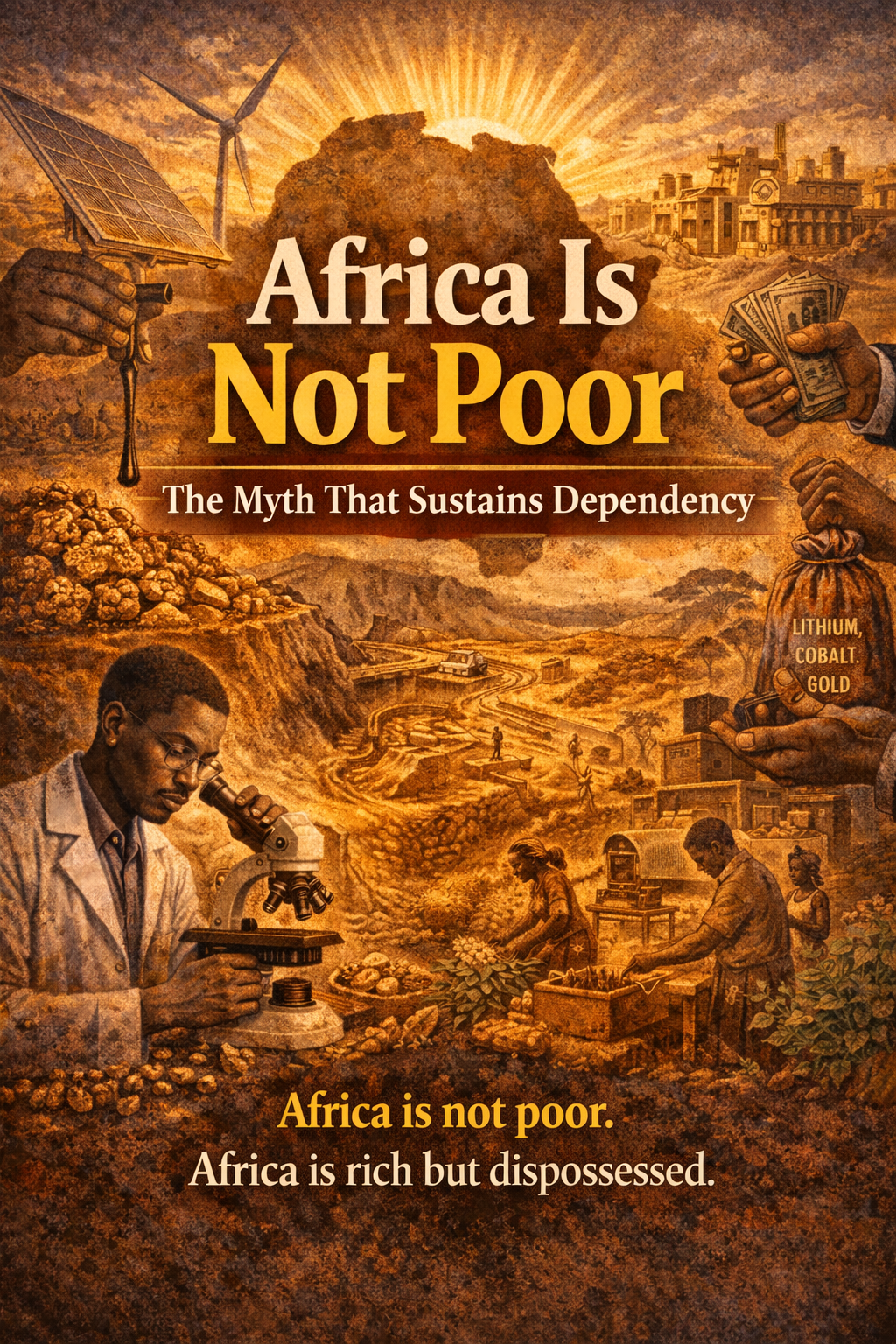

Africa’s most enduring export is not minerals, oil, or labour.
It is a myth.
The myth of African poverty has been repeated so often, so confidently, and so globally that it now masquerades as fact. It shapes policy, aid architecture, investment logic, and even African self-perception. Yet when examined closely, this myth collapses under the weight of evidence.
Africa is not poor. Africa is dispossessed.
Poverty suggests absence. Africa’s reality is abundance systematically mismanaged, extracted, or undervalued. The continent holds vast reserves of arable land, fresh water, minerals critical to the global energy transition, biodiversity essential to medicine, and a youthful population that is the envy of ageing economies. No genuinely poor continent could sustain the global systems that rely so heavily on its resources.
The poverty narrative performs a function. It legitimises external control. If Africa is poor, then intervention is benevolent. If Africa is incapable, then guardianship is justified. If Africa is perpetually in need, then extraction can be framed as assistance.
This narrative obscures the fact that Africa subsidises the world.
Raw materials leave the continent cheaply and return as expensive finished goods. Profits are externalised, while environmental and social costs remain local. Capital flight drains billions annually. Knowledge extracted from African biodiversity and cultures fuels foreign patents and industries.
These are not failures of culture or competence. They are features of an unequal global system sustained by narrative compliance.
Aid, in this context, becomes a management tool rather than a solution. It treats symptoms while preserving structures. It rewards need rather than productivity, compliance rather than sovereignty. Over time, it distorts accountability, weakening the social contract between African states and their citizens.
Yet wherever African leadership prioritises production over perception, the poverty myth falters.
Food security initiatives that reduce imports stabilise economies. Local manufacturing creates employment and retains value. Energy independence through solar reduces vulnerability. Health sovereignty cuts long-term costs. Each act of execution chips away at the fiction of African incapacity.
The most dangerous aspect of the poverty myth is internalisation. When Africans begin to believe that scarcity is natural, ambition contracts. Possibility narrows. Governance lowers its standards. Dependency becomes normalised.
Rejecting the poverty myth is not an act of denial. It is an act of clarity.
Africa does not need rescue. It needs fair terms, disciplined leadership, and the courage to prioritise its own people over external approval. Development will not come from charity, but from control—over resources, narratives, and systems of value creation.
The future belongs not to continents that are pitied, but to those that produce.
Africa is key among them.