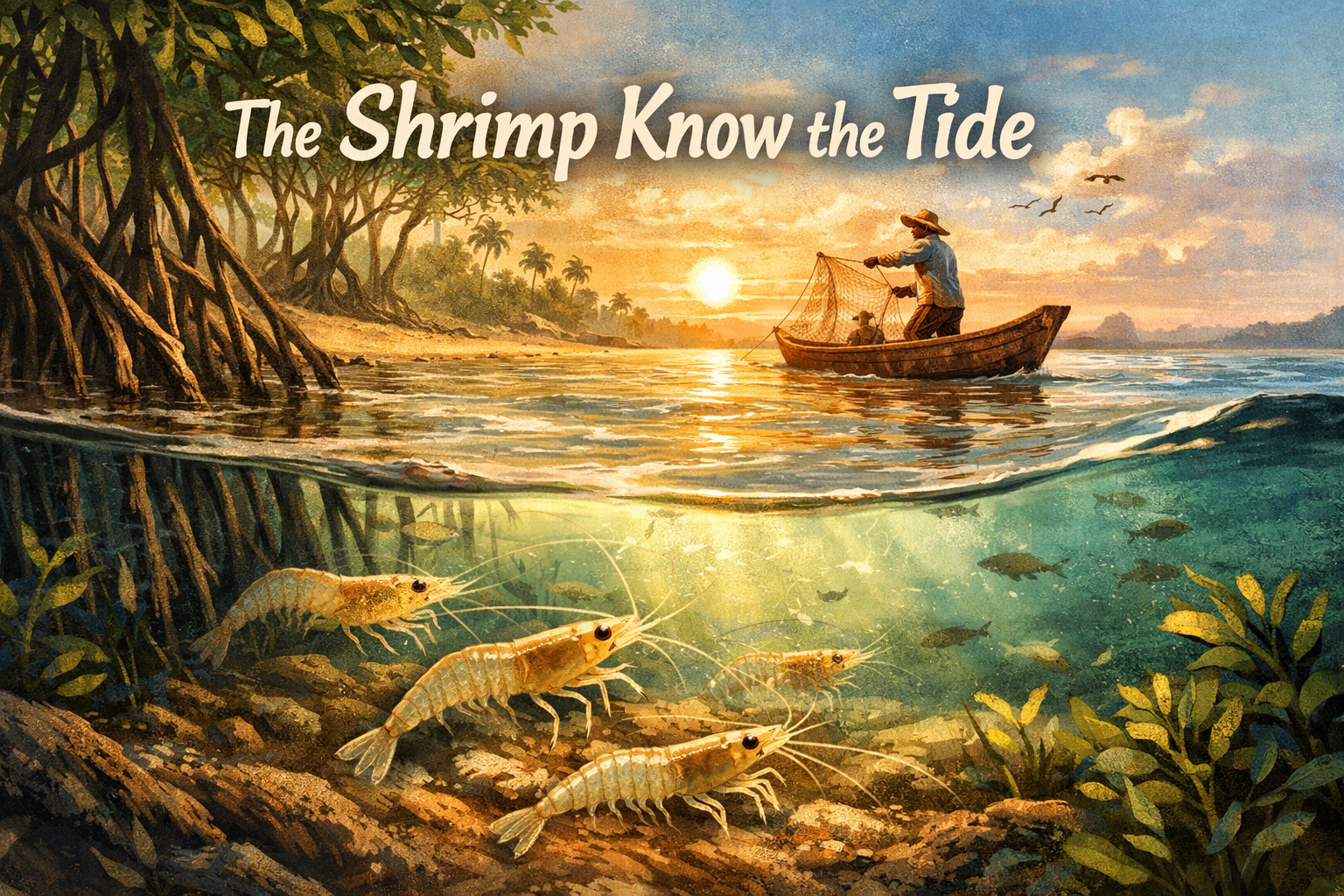

They are born where the river hesitates.
Where fresh water, tired from its long journey inland, meets the salt of the Indian Ocean and pauses, unsure whether to surrender or resist. In that pause, the shrimp begin their lives.
The South Coast understands such in-between places. Mangroves grow there too, roots tangled like unanswered questions, standing in water that is neither fully land nor fully sea. This is where life learns to negotiate rather than conquer.
The shrimp are small, translucent, easily overlooked. The kind of life that never makes demands. They do not rush the tide. They wait for it to call them forward.
When the water pulls back, they hide.
When it returns, they move.
The tide is their clock, their calendar, their teacher.
Above them, the coast wakes slowly. Fishermen step into canoes worn smooth by years of trust. Nets are checked, not hurriedly, but with reverence. The old men read the moon the way others read balance sheets, knowing that timing is wealth, and impatience is debt.
The shrimp feed in silence. They clean the water, recycle what others discard, sustain a food chain that stretches far beyond their size. They are economy without noise. Value without visibility.
By midmorning, some will be caught. Not all. Not always. The wise fishermen take what the tide allows and leave what tomorrow requires. They know that abundance is not found in taking more, but in returning often.
In kitchens along the coast, shrimp crackle in pans kissed by coconut oil. They thicken stews. They stretch meals. They turn small earnings into school uniforms, medicine, dignity. No one applauds. The work simply continues.
But the shrimp are sensitive witnesses.
When mangroves are cut for quick profit, their nurseries collapse.
When rivers carry poison from careless upstream hands, the shrimp absorb the punishment quietly.
When nets are dragged without restraint, they disappear—not in protest, but in consequence.
The coast then learns what absence feels like.
No stew thick enough.
No catch worth the early morning.
No tide that seems to give anymore.
And yet, when care returns, so do the shrimp.
When mangroves are replanted.
When fishing respects season and size.
When restraint is remembered as wisdom, not weakness.
They return without ceremony. Small again. Faithful again. Teaching the same lesson they always have: that life survives not through domination, but through alignment.
The shrimp know the tide.
They know when to move and when to wait.
When to feed and when to hide.
When enough is enough.
Perhaps that is why the South Coast endures. Because beneath the white sands and blue waters lies an economy that listens to seasons, to silence, to the fragile agreements that keep both people and nature alive.
And every dawn, before the sun learns how to burn, the shrimp rise again, carrying the quiet wealth of the coast in their translucent bodies,
asking only that we learn to see what feeds us before it is gone.