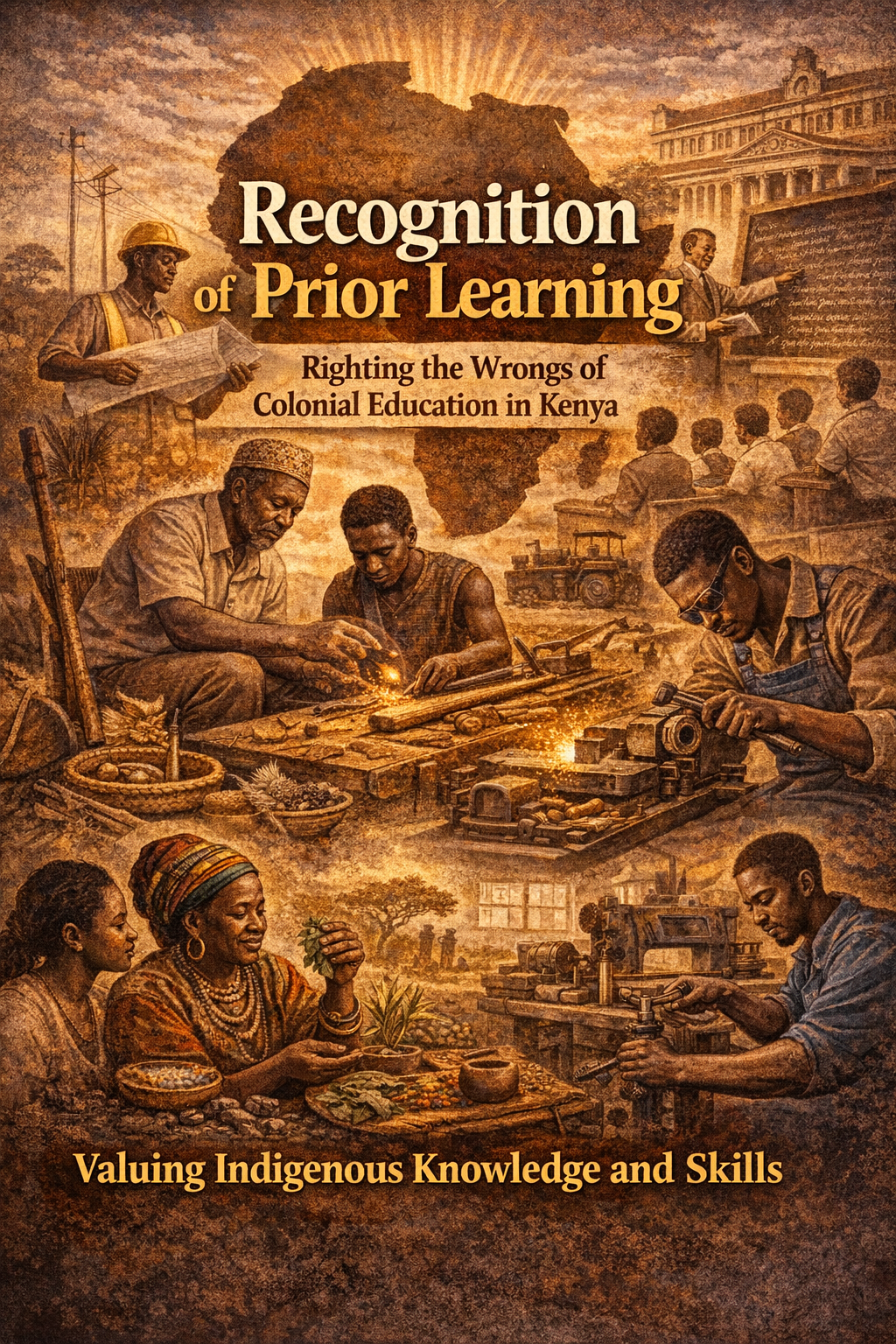

Righting the Wrongs of Colonial Education in Kenya
Kenya’s education system, like those of many formerly colonised societies, was not designed to recognise African knowledge, skills, or modes of learning. It was engineered to replace them. Colonial education privileged written examinations, foreign languages, and European epistemologies while systematically delegitimising indigenous knowledge, apprenticeship, oral traditions, and community-based learning. The consequences of this historical distortion are still with us.
Recognition of Prior Learning (RPL) offers Kenya a powerful opportunity to confront this legacy and begin to repair it.
The Colonial Roots of Educational Exclusion
Colonial education in Kenya was never neutral. It was selective by design, preparing a small African elite for clerical and subordinate roles while rendering the vast majority of Africans “unqualified” by imported standards. Skills acquired through farming, craftsmanship, healing, trade, governance, and environmental stewardship were dismissed as informal, unscientific, or backward.
Even after independence, the colonial architecture of education remained largely intact. Formal certification became the primary gatekeeper to employment, advancement, and social legitimacy. Millions of Kenyans with deep, practical expertise found themselves excluded not because they lacked competence, but because they lacked paper credentials that the system itself had historically denied them.
This is not merely an administrative oversight. It is a structural injustice.
What Recognition of Prior Learning Really Means
Recognition of Prior Learning is the formal acknowledgement of knowledge and skills acquired outside traditional classrooms. These may be gained through work experience, community leadership, entrepreneurship, indigenous practices, informal training, or self-directed learning.
In a Kenyan context, RPL has profound implications. It affirms that learning happens everywhere, not only in schools. It recognises the mechanic who learned through apprenticeship, the farmer whose generational knowledge sustains food systems, the midwife whose expertise predates biomedical certification, and the artisan whose craft embodies centuries of innovation.
RPL does not lower standards. It broadens the lens through which competence is assessed.
RPL as a Decolonial Intervention
At its core, RPL challenges the colonial hierarchy of knowledge. It refuses the assumption that Western, classroom-based learning is the sole or superior path to expertise. Instead, it restores dignity to African ways of knowing.
By valuing experiential and indigenous knowledge, RPL aligns with Kenya’s constitutional commitment to social justice, inclusion, and human dignity. It also resonates with African philosophies that understand knowledge as lived, relational, and embedded in community.
In this sense, RPL is not just an education reform. It is an act of epistemic justice.
Economic Justice and National Development
The exclusionary legacy of colonial education has real economic costs. Kenya faces paradoxical skills shortages alongside widespread unemployment. Many skilled individuals remain locked out of formal employment, professional progression, and public procurement because they lack recognised qualifications.
RPL can unlock this dormant capacity. By certifying existing competencies, it allows workers to upskill, reskill, and transition across sectors without starting from zero. It supports lifelong learning and creates pathways for informal sector actors to enter the formal economy. For a country where the informal sector employs the majority of the workforce, this is not optional. It is essential.
Bridging Generations and Preserving Indigenous Knowledge
Colonial education severed intergenerational transmission of knowledge by privileging the school over the community and the textbook over the elder. As a result, many indigenous practices are endangered.
RPL offers a mechanism to document, validate, and transmit this knowledge in contemporary forms. It can help integrate traditional ecological knowledge into climate adaptation, indigenous medicine into wellness systems, and artisanal skills into creative industries.
In doing so, RPL connects the past to the future without romanticising or freezing tradition.
Challenges and the Risk of Superficial Reform
For RPL to truly address colonial injustice, it must not become a bureaucratic exercise that simply mimics Western assessment models. If evaluation frameworks privilege written English assessments, urban norms, or institutional bias, RPL risks reproducing the very exclusions it seeks to undo.
Effective RPL requires culturally responsive assessment, community involvement, sector-specific standards, and sustained public awareness. It also demands political will, adequate funding, and strong coordination between education institutions, industry, and communities.
Decolonisation cannot be outsourced or rushed.
Towards an Inclusive Knowledge Economy
Recognition of Prior Learning invites Kenya to ask a deeper question: whose knowledge counts?
By affirming the legitimacy of learning acquired beyond colonial classrooms, RPL helps dismantle inherited hierarchies and build a more inclusive, confident, and productive society. It restores value to those long told they were unqualified, and it enriches the nation by recognising the full spectrum of its human capital. In this way, RPL is not simply about certificates. It is about memory, dignity, and the unfinished work of independence.